Declared trust signal
Connections instrument. Roughly 2 million employees. Refusal-as-data. Rather not answer as declared signal, not missing data.
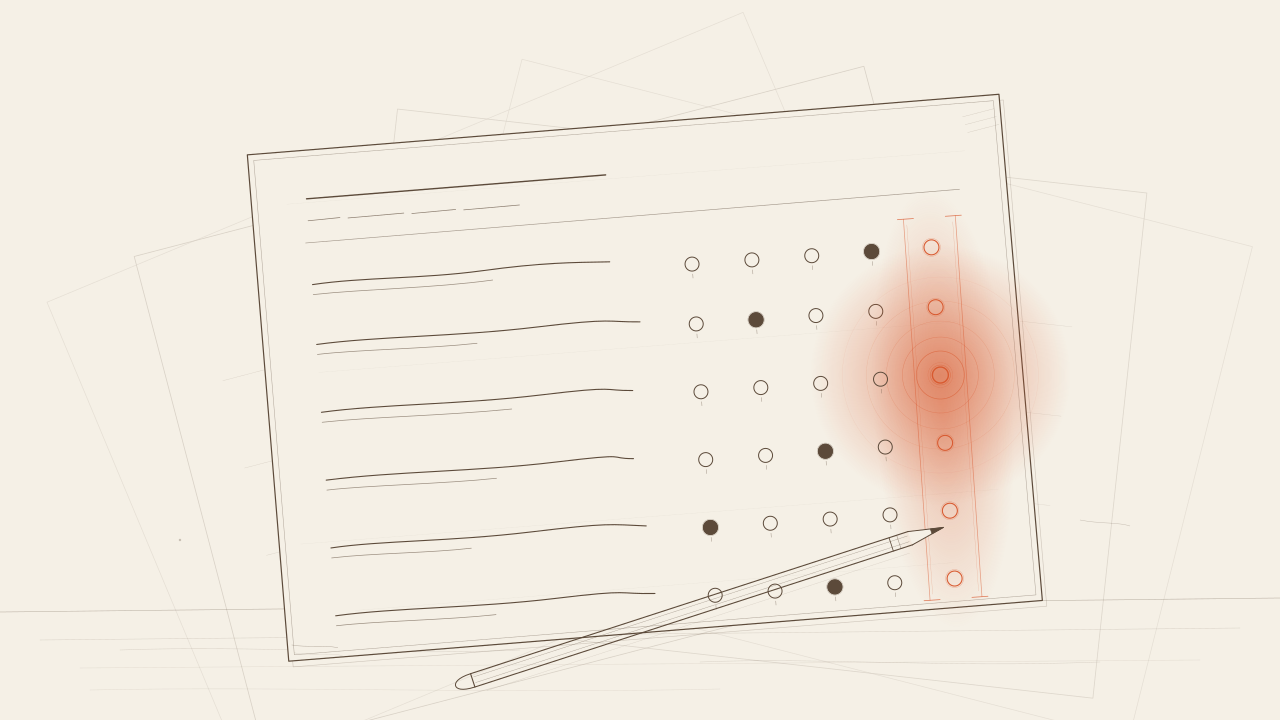
HR leadership wanted deficit data for actionable insights. The original instrument framed questions in deficit language: what's broken, who's at risk. Asking what's wrong every day doesn't only measure sentiment. It shapes it. Refusal rates were climbing in the population HR was furthest from. The L1 to L3 frontline. The responses coming back were performative. The third door was small: treat the refusal as the most honest thing the person said that day.
Read the case What shipped, how it worked, the lines that land

Role and scope
Product Manager on the daily sentiment instrument for roughly two million employees.
What I shipped
Strength-Based Signals
Rewrote the question architecture using a strengths-based methodology. Kept the deficit signal intact. Made rather not answer a first-class affordance so refusal itself became data.
- Designed confidentiality safeguards and minimum leader-action contracts so the refusal affordance was protected by structure, not by promise.
- Delivered seven programmatic recommendations with KPIs and a portfolio rollout plan.
- Cross-functional partners: industrial and organizational psychology research scientists, content managers, HR business partners, L1 to L3 management.
Trust and Traction
Defined Trust as a measurable product metric, not a vibe. Drove confidentiality controls and lifted survey participation in a 300K-employee operations cohort. +10% daily active users on the instrument.
Results
- 120k to 300k participation in the frontline (L1 to L3) segment after the rewrite (+40%).
- 3x lift in response rate at roughly 2M-employee scale while preserving the deficit and risk signal HR originally asked for.
- Rather not answer frequency became a trust diagnostic. It surfaced exactly where trust eroded or social pressure compressed honesty.
- Quantitative work in the adjacent role processed 39 million survey responses. Surfaced a U-shaped engagement curve by tenure.
The architectural reframe
Trust is a system property, not a feature. It's earned by three structural commitments.
- Confidentiality safeguards that survive procurement, not just promises.
- Minimum leader-action contracts. Results obligate response.
- An explicit refusal pathway treated as declared data, not missing data.
That's the load-bearing claim. Declared refusal beats inferred sentiment.
Craft: how it actually worked
Strengths-frame, deficit-signal preserved
The original asked "What's broken on your team this week?" The rewrite asked "What's working well enough that you'd want more of it?" plus an explicit Rather Not Answer path that surfaced to the same dashboard. The construct measured stayed intact. The shaping effect on the rater inverted.
Rather not answer, designed
Specific visual treatment. Default state next to strongly-disagree. Telemetry routed downstream as its own typed event. The thing every other instrument treats as missing data became a primary metric.
Minimum leader-action
Leaders could not see their team's results until they committed to a published response window. Confidentiality protected by structure (workflow gates), not by promises (policy text). The instrument enforced its own social contract.
Design for the furthest population
Two-million-employee instruments default to averaging the frontline away. The L1 to L3 cohort was the design target because their refusal rate was highest, which meant their signal was the most diagnostic of where trust eroded.
The refusal is the signal. Treat rather not answer as missing data and you discard the most diagnostic measurement in the instrument.
See the proof Composition, primitives, first principles

Asking shapes what you measure. At two-million-employee daily cadence, the instrument is the culture.
Primitives: the reusable architecture
Three trust contracts
Together they constitute the load-bearing claim that trust is a system property, not a feature.
- Confidentiality that survives procurement: not promises in the help docs, controls in the data layer.
- Minimum leader-action obligation: results obligate response. No silent reads.
- Refusal-as-declared-data: rather not answer is a typed event with downstream consequences.
Refusal-as-signal
The most under-used primitive in measurement. Refusal carries information about the environment that compelled it. Treating refusal as missing data discards that information. Treating refusal as declared data preserves it.
Question-as-product
The question architecture is the product architecture. Deficit-framed instruments produce deficit-framed cultures and vice versa, at scale, daily. The instrument is a ritual. The ritual is culture.
How this composes
- Instill Refusal-as-architecture at the product-design layer.
- Clause Same banded shape: proceed, warnings, block.
- Oracle Refusal as a typed event in the store.
- Declaration Declared scope binds what any guest can infer.
Design for the population you're furthest from. Their refusal rate is the diagnostic.
First principles
Asking shapes what you measure
Measurement is never neutral at two-million-employee daily cadence. The instrument is the culture insofar as it asks the same population the same question every day. Choose the question architecture as carefully as the model architecture.
Trust is a measurable product property
Earned by structural commitments. Workflow gates, audit trails, minimum-action contracts. Not by saying we promise. If a trust claim can't be verified by inspection, it isn't trust. It's PR.
Design for the population you're furthest from
The cohort with the lowest baseline trust carries the highest diagnostic signal. Designing for them lifts the whole. The opposite move, designing for the cohort easiest to reach, produces instruments that confirm what HR already believed.
Why this matters
Constitutional eval and red-team feedback have the same shape. The refusal is the signal. At scale, declared refusal beats inferred sentiment. RLHF data quality depends on this exact discipline. Ask in a way that respects the rater. Treat refusal as data. Protect the refusal pathway by structure.
Trust is a system property, not a feature. It's earned by structural commitments, not by saying we promise.