Consent verification primitive
Agentic consent verification layer. Declared values operationalized at the individual level for the agentic economy.
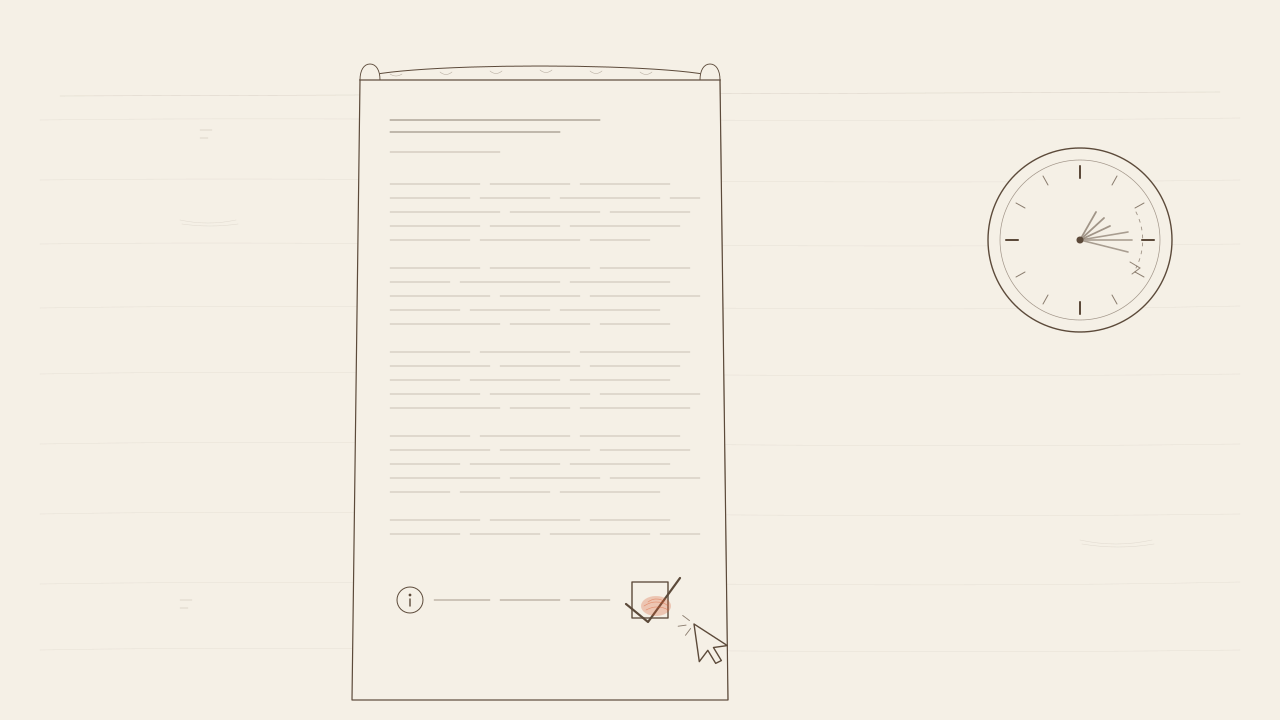
The person clicking I agree is no longer a person. The agentic economy moves the act of consent from human attention to delegated agent authority. The risk surface moves with it. We've spent twenty years designing consent for human attention failure. We haven't yet designed consent for delegated authority failure. That's the gap Clause fills.
Read the case What shipped, how it worked, the lines that land
What Clause is, in one paragraph
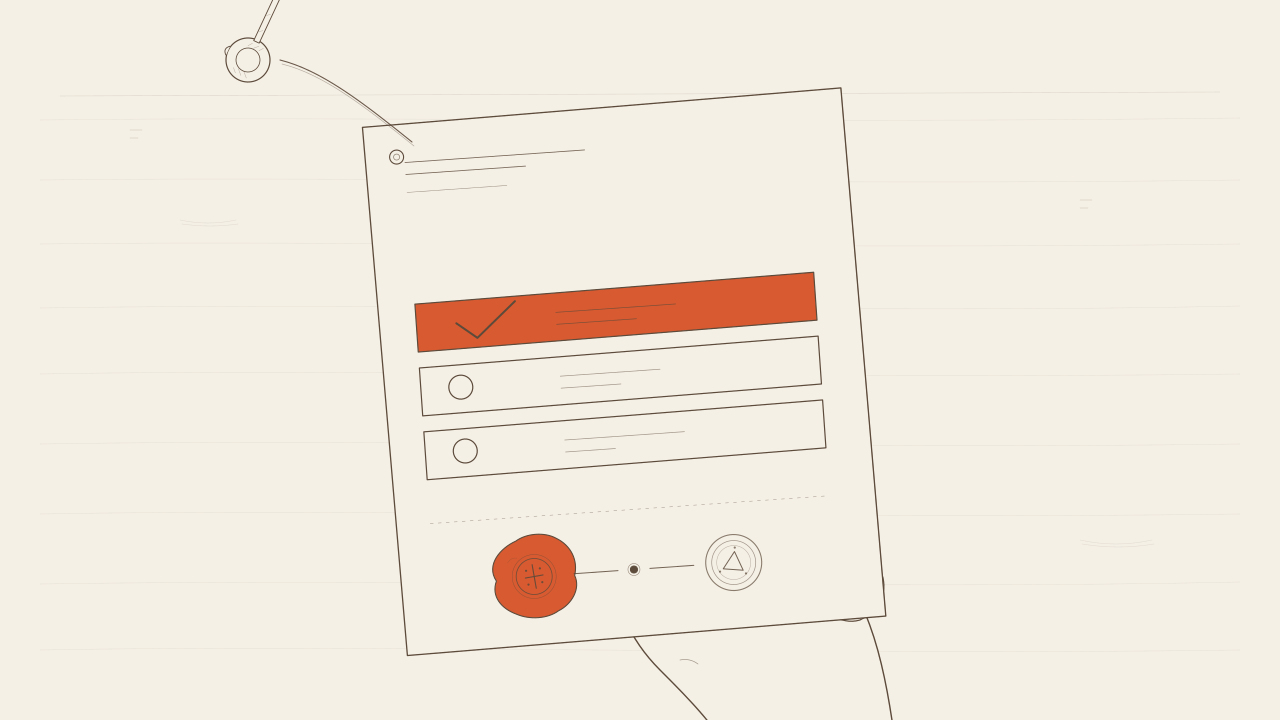
Clause is a verification layer for the agentic economy. Before an agent signs, buys, or commits a human to a contract, it calls a verification endpoint. Terms go in. The human's consent profile goes in. A verdict comes out: proceed, proceed with warnings, or block. Every verdict is recorded as a signed receipt in a hash-chained ledger that lives inside the human's own sovereign infrastructure. The human can read it, query it, prove it, and revoke it. Forever.
Three primitives (consent profile, terms hash, verdict signal) sealed by a fourth: the receipt.
Core primitives
- Consent profile: machine-readable declaration of what a human allows and refuses (data sharing, training use, arbitration, jurisdiction, risk tolerance).
- Terms hash: deterministic fingerprint so the system can cache analyses, prove what was evaluated, and detect silent changes.
- Verdict signal: proceed, proceed-with-warnings, or block. Banded, machine-consumable.
- Clause flags: named, typed findings with severity, plain-language summary, and source location.
- Receipt: Ed25519-signed, append-only, hash-chained. The human's countersigned record of every consent moment.
Why now
Three forces converging.
- Agents at scale. Every major model lab is shipping tool-calling, browser-using, contract-signing agents this year. The 2007 "check the I agree box" assumption breaks the moment the box is checked by software.
- Regulators pre-positioning. California's DELETE Act enforcement begins this summer. CPPA is writing rules for automated decisioning right now. The first jurisdiction to require receipt-grade proof of consent creates a multi-billion-dollar market overnight.
- OpenAI Ads launching. CPC bidding plus Conversions API plus self-serve onboarding make conversational commerce infrastructure. Consent verification stops being a nice-to-have.
First proving ground
The first live consent-protocol deployment. Challenge-token handshake gates agent access behind terms acceptance. Ed25519-signed consent receipts prove what was agreed. Cryptographic provenance headers trace every data payload.
Every pattern validated there becomes a reusable primitive in Clause's SDK.
The declared-vs-inferred move
Today's consent UX infers what the user agreed to from a click. Clause makes the agreement declared, signed, and queryable. At atomic granularity, on the user's hardware. The consent profile is the declared frame the agent operates inside. The verdict is bounded by what the human authored, not by what the platform inferred about them.
The person clicking I agree is no longer a person. The architectural unit of consent has to move with that fact.
See the proof Composition, primitives, first principles
We spent twenty years designing consent for human attention failure. We haven't yet designed consent for delegated authority failure. That's the gap Clause fills.
Primitives: the reusable architecture
Pre-transaction verification
The consent moment moves before the act, not after. This inverts twenty years of click-then-consent UX. The endpoint is callable, programmable, and bounded by what the human authored.
Consent as declared scope
Machine-readable, queryable by the human, not by the platform. The profile lives in the sovereign cell. The platform asks. The user answers. The asymmetry is the architecture.
Receipts as portable proof
The user carries, proves, and revokes consent state across platforms. Cryptography replaces the help-desk. Receipts are first-class objects, not log lines.
How this composes
- Oracle The receipt is a semantic event.
- Amazon The block verdict is the structured refusal.
- Instill The consent profile is the architecture that refuses.
- Declaration Clause Ink is the Notary implementation.
Consent is a protocol, not a policy. Anything weaker is recapturable.
First principles
The person clicking I agree is no longer a person
The architectural unit of consent has to move from user-as-attention to user-as-sovereign-frame. Once agents click on behalf of humans, the click can no longer carry the consent. Something else must.
Consent is a protocol, not a policy
Policies require trust in the platform. Protocols require cryptography and shared state. Anything weaker than a protocol is recapturable.
The verdict belongs to the human, not the platform
The endpoint runs in the user's sovereign cell. The platform asks. The user answers. Inversion of authority is the entire move.
Why this matters
This is the provenance layer agent observability needs. MCP standardizes how agents call tools. Clause standardizes the consent surface those calls must clear before any irreversible act. Interpretability gains a regulatory and commercial twin: receipts that prove what an agent did, scoped to what the human authorized.
The verdict belongs to the human, not the platform.